
Find the right glass fiber optic light guide for your industrial sensing application.
Selecting the correct glass fiber optic light guide is essential for reliable photoelectric sensing. Different configurations, sizes, protective jackets, and sensing tips allow fiber optics to operate in a wide variety of industrial environments. The following six steps will help you
identify the fiber optic construction best suited to your equipment, operating conditions, and detection requirements.
Before You BeginConsider your sensing mode, available mounting space, operating temperature, exposure to moisture, and the size of the object being detected. These factors will help guide your selection.
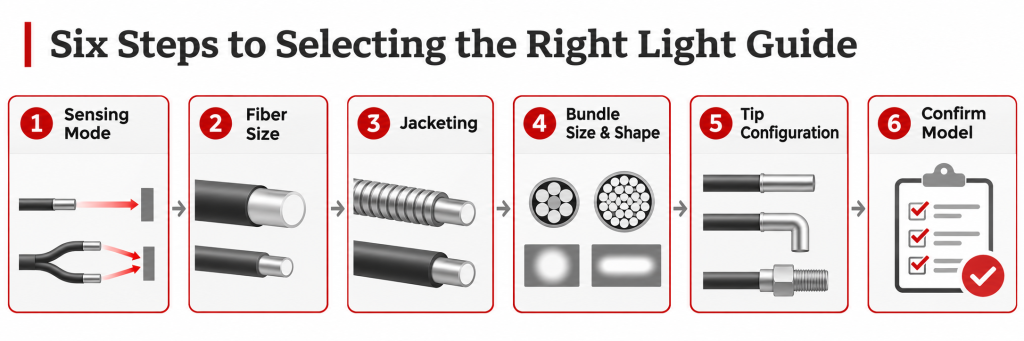
Follow these six steps to determine the sensing mode, fiber size, protective jacketing, optical bundle, and tip configuration that best meets your application requirements.
|
1 Select Your Sensing Mode SENSING CONFIGURATION Begin by selecting the sensing mode best suited to your application. Straight Light Guides Typically used in pairs for Beam Break / Thru-Beam (Opposed) sensing. Bifurcated Light Guides Commonly used for Beam Make / Optical Proximity sensing, or retroreflective applications. Choose the configuration that provides dependable detection |
2 Choose Your Fiber Size STANDARD OR MINIATURE Determine whether a standard-size or miniature glass fiber optic Standard Fibers A practical choice for general industrial applications where adequate mounting space is available. Miniature Fibers Designed for compact installations, confined sensing areas, and applications requiring smaller sensing tips. Consider available mounting space, fiber size, and required optical performance when choosing. |
|
3 Select Protective Jacketing ENVIRONMENTAL PROTECTION The protective jacket helps protect the glass fibers from physical damage and challenging industrial conditions. Stainless Steel Armored Cable Recommended for most general industrial applications, including appropriately rated high-temperature environments. PVC Jacketed Monocoil Recommended for specified wet applications where moisture protection is required. Always confirm the environmental and temperature ratings of the |
4 Select Fiber Bundle Size & Shape OPTICAL PERFORMANCE The size and shape of the fiber optic bundle influence the sensing system’s transmitted light beam and effective viewing area. Select a bundle that provides the required detection area while maximizing the difference between the light received with and without the target. Optimize Contrast Choose the bundle configuration that provides the greatest The proper optical configuration helps ensure reliable detection across changing application conditions. |
|
5 Select Your Sensing Tip MOUNTING & ALIGNMENT Choose a sensing tip configuration that fits your installation and Available configurations include:
Consider mounting clearance, tip orientation, alignment, and environmental requirements when selecting your tip. |
6Confirm Your Fiber Optic Model FINAL PRODUCT SELECTION Once you’ve selected the sensing mode, fiber size, protective jacket, bundle configuration, and sensing tip, the final step is identifying Fiber optic model numbers identify the construction and configuration of the light guide. Need Selection Assistance? Excel Automation can help identify the appropriate fiber optic model based on your specifications and application needs. Contact our team to confirm available configurations, part numbers, and pricing. |
Quick Fiber Optic Selection Reference
Not sure whether straight or bifurcated fiber optic light guides are right for your application? Compare their common uses below.
Straight Light GuidesCommonly selected when:
|
Bifurcated Light GuidesCommonly selected when:
|
Selection Tip:
The best fiber optic light guide is one that provides dependable optical performance while meeting the physical, environmental, and mounting requirements of your application.
Need a Custom Fiber Optic Light Guide?
Not every industrial sensing application can be solved with a standard fiber optic configuration.
Excel Automation can help provide custom fiber optic light guides designed and manufactured to meet your specifications.
Whether you need a specialized fiber length, unique sensing tip, optical bundle, or custom construction, our team can help identify a
solution for your requirements.